Research area
Reaction Mechanism and Kinetics
To develop high-performance catalytic materials, it is essential to understand reaction mechanisms occurring on catalyst surfaces. Using density functional theory (DFT) calculations, we can quantify the energetic requirements of chemical reactions, including reaction energies and activation barriers. From this information, we can further estimate reaction rates and kinetics.
These energetic and kinetic properties strongly depend on the nature of the catalyst and the surrounding reaction environment. By virtually tuning the identity of catalytic materials or modifying reaction conditions, we can systematically screen a wide range of candidate materials and identify promising catalysts that enhance the desired chemical reactions.
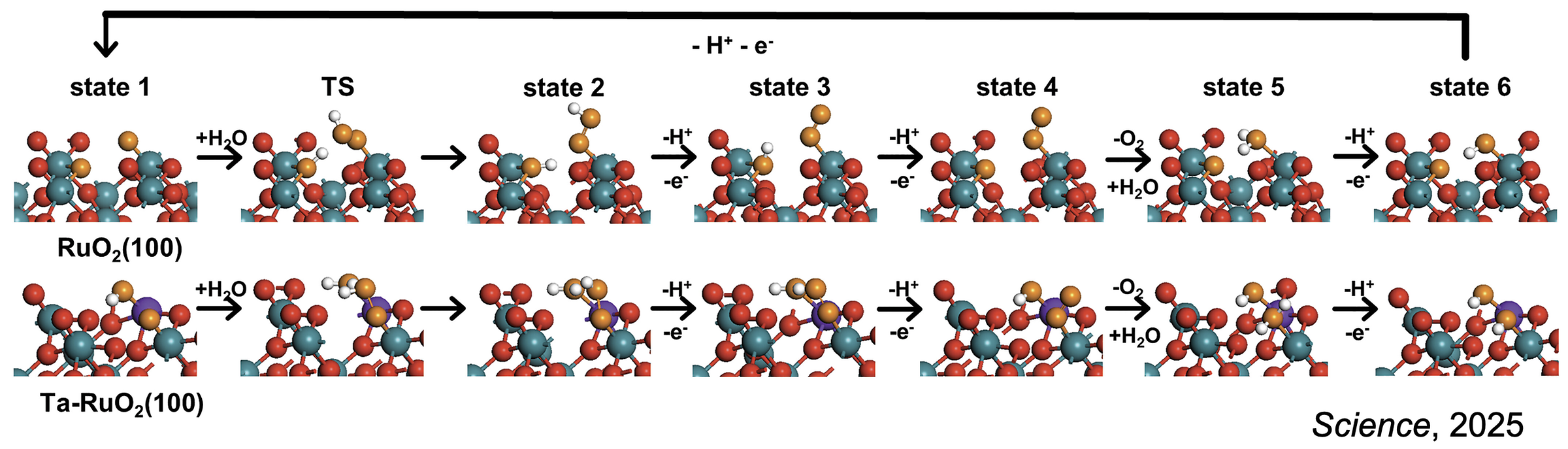
Grand canonical DFT calculations
Conventional density functional theory (DFT) calculations are typically limited to charge-neutral systems. In contrast, electrochemical reactions occur under an applied bias, where the number of electrons in the system continuously varies. As a result, standard DFT approaches cannot directly capture the effect of electrode potential on reaction energetics and kinetics. Grand canonical DFT (GC-DFT) overcomes this limitation by allowing the number of electrons to change at a fixed electrochemical potential, thereby accurately describing the charging behavior of electrochemical interfaces. This framework enables direct and quantitative comparisons between computed reaction energetics and kinetics and experimental electrochemical measurements. In our research, we employ grand canonical DFT to investigate potential-dependent reaction mechanisms and catalytic activity at electrified interfaces, providing realistic atomic-level insights into electrochemical processes under operating conditions.
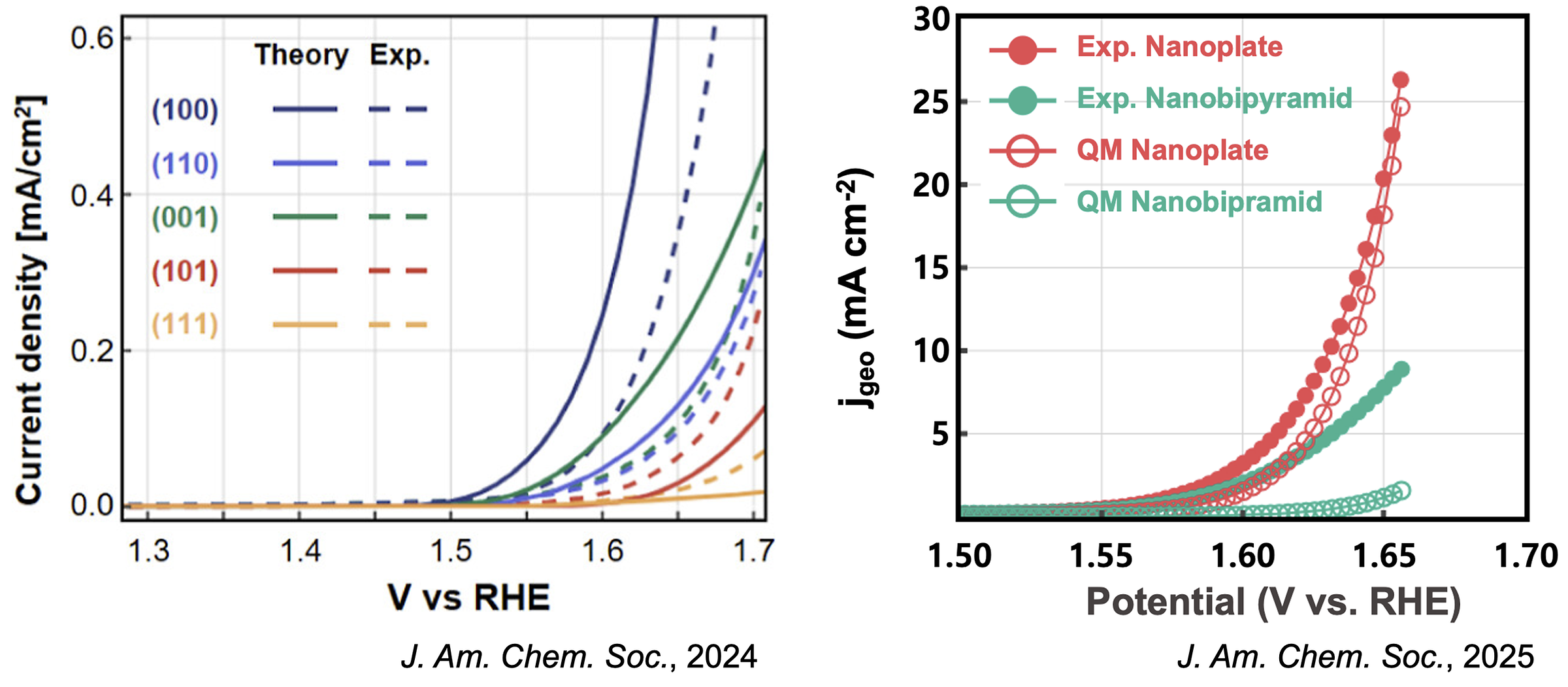
Multiscale Dynamics
Multiscale molecular dynamics simulations enable us to track atomic trajectories in complex systems across a wide range of spatial and temporal scales. Depending on the length and time scales of interest, as well as the specific goals of the simulation, we employ different computational approaches. Ab initio molecular dynamics (AIMD) provides quantum-mechanical accuracy for the entire system, naturally allowing for the formation and cleavage of chemical bonds. However, AIMD is typically limited to systems containing a few hundred atoms and simulation times of less than 1 ns. In contrast, classical force-field-based molecular dynamics (MD) can be applied to systems comprising millions of atoms, reaching timescales up to microseconds. Through classical MD simulations, we can efficiently evaluate equilibrium structures of complex systems as well as mass transport properties, such as diffusion and ionic conductivity, under realistic conditions.
Grand Canonical Ab-initio Molecular Dynamics of Oxide-Water Interface
Reactive Force Field Simulation of Metal Nanowire Oxidation
Right: Time trajectory of oxidation process, Left: Real-time oxidation state of metal element
Method Development
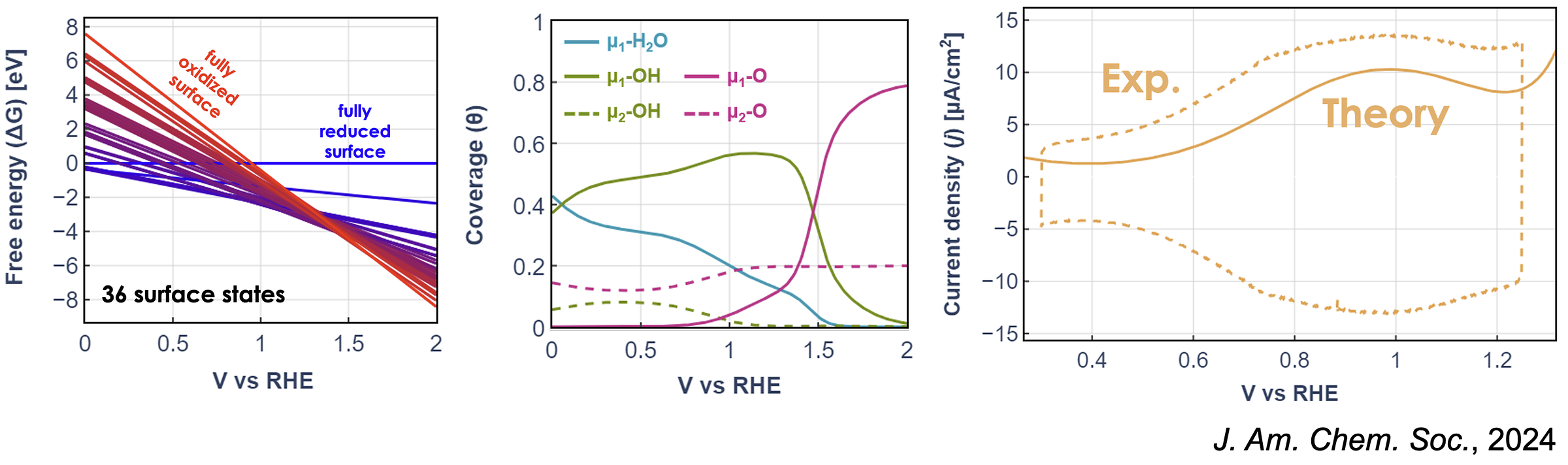
Cyclic Voltammetry Simulation
Cyclic voltammetry (CV) is one of the most fundamental experimental techniques in electrochemistry, providing a direct current response to an applied potential. Despite its apparent simplicity, CV contains rich and invaluable information about electrochemical systems. In our research, we simulate CV curves using a bottom-up, atomistic approach based on the energetics of redox reactions occurring at electrode surfaces. This framework enables us to elucidate how surface intermediates evolve as a function of the applied potential. By directly comparing simulated CVs with experimental measurements, we can rigorously validate our theoretical models and gain mechanistic insight into electrochemical processes.
Hybrid QM/MM scheme
Hybrid Quantum Mechanics/Molecular Mechanics (QM/MM) methods are well established in the field of biomolecular simulations. This approach partitions the entire system into two subsystems: a QM region, where a quantum-mechanical description is required (e.g., ligand binding sites in proteins), and an MM region, where chemical reactions do not occur and classical force fields are sufficient. In electrocatalytic systems, however, proton (H⁺) diffusion is strongly coupled with the solvent environment, involving frequent formation and cleavage of chemical bonds with surrounding water molecules. Such processes inherently require a QM-level description. This coupling complicates the application of conventional QM/MM methods, as the boundary between the QM and MM regions is neither fixed nor clearly defined, but instead changes dynamically due to proton hopping. To overcome this limitation, we have developed an adaptive boundary-shifting QM/MM method that enables real-time simulation of proton (and hydroxide) diffusion and their recombination in aqueous environments, where the solvation shells of H⁺ and OH⁻ continuously evolve. This approach naturally captures dynamic proton transfer processes while maintaining computational efficiency. Furthermore, the method can be extended to investigate other mass transport phenomena, such as lithium-ion diffusion in polymer electrolytes (e.g., Nafion).
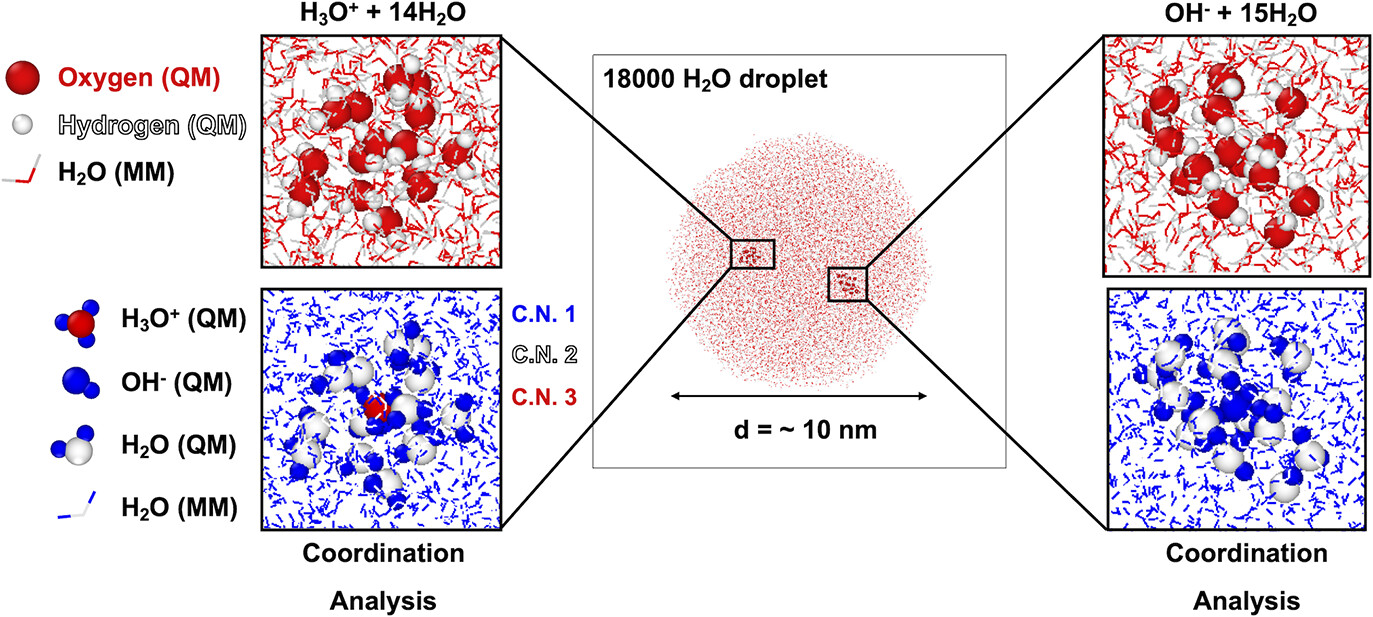
H+ and OH- recombination process in water
Applications
Water Electrolysis
Green hydrogen is hydrogen gas produced by directly splitting the H–O bonds of water molecules using sustainable energy sources such as photovoltaic cells or wind turbines. However, in addition to the high cost of renewable electricity and the limited scale of current production, the reliance on expensive catalysts, such as iridium, makes it challenging to achieve the ultimate cost target of $1 per kg of H2. In our research, we have investigated the gold-standard IrO2 catalyst through atomistic modeling to uncover its activity and stability at the atomic level. Based on these insights, we explore strategies to reduce iridium loading or partially substitute iridium with ruthenium, which is approximately ten times less expensive, while maintaining high catalytic performance.
Fuel Cell
Efficient utilization of hydrogen is a key requirement for building a sustainable energy society. In fuel cells, hydrogen is electrochemically converted into electricity and water, offering a clean and highly efficient energy conversion pathway. However, the performance and durability of fuel cells are strongly limited by sluggish electrode reactions at the anode and the use of costly platinum-based catalysts. Our research focuses on understanding electrode reaction mechanisms and we aim to design high-performance and cost-effective catalysts that enable efficient hydrogen utilization with reduced precious-metal content.
CO2 Conversion
Electrochemical CO2 conversion provides a promising route to transform carbon dioxide into value-added chemicals and fuels, such as carbon monoxide, hydrocarbons, and alcohols, using renewable electricity. Despite its potential, CO2 reduction suffers from limited energy efficiency and low selectivity due to competing side reactions. Using first-principles calculations and molecular simulations, we investigate reaction pathways and catalyst–electrolyte interactions on catalytic surfaces. Our goal is to establish atomic-level design principles that enable selective and efficient CO2 conversion, contributing to carbon-neutral energy cycles.